WildFin: An In-the-Wild Dataset for Fish Behavioral Recognition
Abigail G. Grassick1,*iD,
Jerome Tze-Hou Hsu1,*iD,
Ethan Lin1,*iD,
Ziang Liu1iD,
Max Whitton1,
Madelyn Hair2iD,
Liam Gutierrez2,
Haozheng Yu1iD,
Kristin Branson3iD,
Vivek Jayaraman3iD,
Michael A. Gil2iD,
Andrew M. Hein1iD,
Jennifer J. Sun1iD
1 Cornell University2 University of Colorado Boulder3 HHMI Janelia Research Campus
Recent advances in field technology have led to a massive influx of in-the-wild video data for
ecological science. The primary bottleneck in leveraging this data is the high cost of expert
annotation. While computer vision offers a potential solution, current models frequently fail when
deployed in complex marine environments. To characterize these failures, we introduce WildFin, a
novel benchmark for fish behavior recognition collected and annotated by ecologists. WildFin spans
two critical real-world paradigms: stationary cameras monitoring groups of fish and dynamic divers
following individual subjects. The dataset represents a massive curation effort, involving 1,350
hours of fieldwork and 600 hours of expert annotation to produce 9 hours of behavioral data with over
2 million frame-by-frame labels. We benchmark modern vision foundation models and quantify tradeoffs
between static and spatiotemporal architectures, revealing the substantial gap that remains between
current model capabilities and the demands of real-world underwater behavioral analysis.
Motivation
Many in-situ or “in the wild” marine ecology pipelines require the annotation of fish
behavior from raw video. Historically, domain experts spend many hours manually annotating this
behavior data (including in our work), and thus it is extremely expensive to gather enough data to
generate any downstream ecological insights.
With recent advances in computer vision, the automation of labeling ecological behavior data is
becoming increasingly possible. WildFin is a new benchmark to evaluate the performance of computer
vision models on fish behavior classification tasks in real-world ecological data --- the
data that ecologists actually use for science.
In addition to benchmarking vision model capabilities, we are excited to see how WildFin can bridge the gap between computer vision research and the practical challenges of ecological applications.
Dataset Details
WildFin is composed of two datasets, CoralCam and FishFollow, that
benchmark fish behavior recognition across two different real-world data-collection paradigms. We
provide short Colab notebooks showing how to load and work with each dataset
(CoralCam /
FishFollow).
We recommend using our codebase VisionBench
when training models on the dataset. It is a modular and scalable PyTorch framework for video
classification tasks and handles many of the challenges of working with large amounts of video data.
Fixed cameras observe schools of brown chromis across 12 wild reef sites in Curaçao, capturing
dense social behavior amid occlusion, small fish, and complex coral backgrounds.
Footage
1.2 hours · 258,998 frames
Capture
12 sites · 1080p at 60 fps
Behavior labels
213 verified tracks · 3 behaviors
Detection labels
21,116 boxes · 3 species
Quality control
Inter-annotator F1 0.74
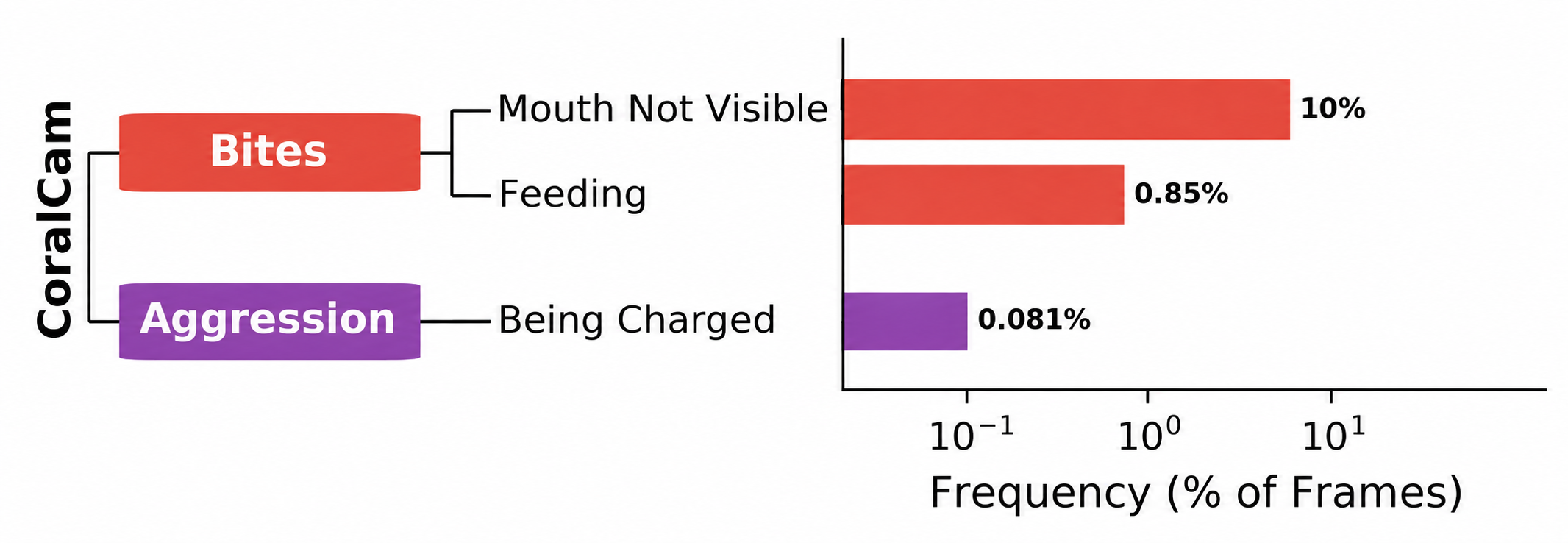
CoralCam Ethogram
CoralCam behavior ethogram. Bars show the percentage of annotated frames assigned to each
behavior; labels may overlap under frame-level multi-label annotation. Select to enlarge.
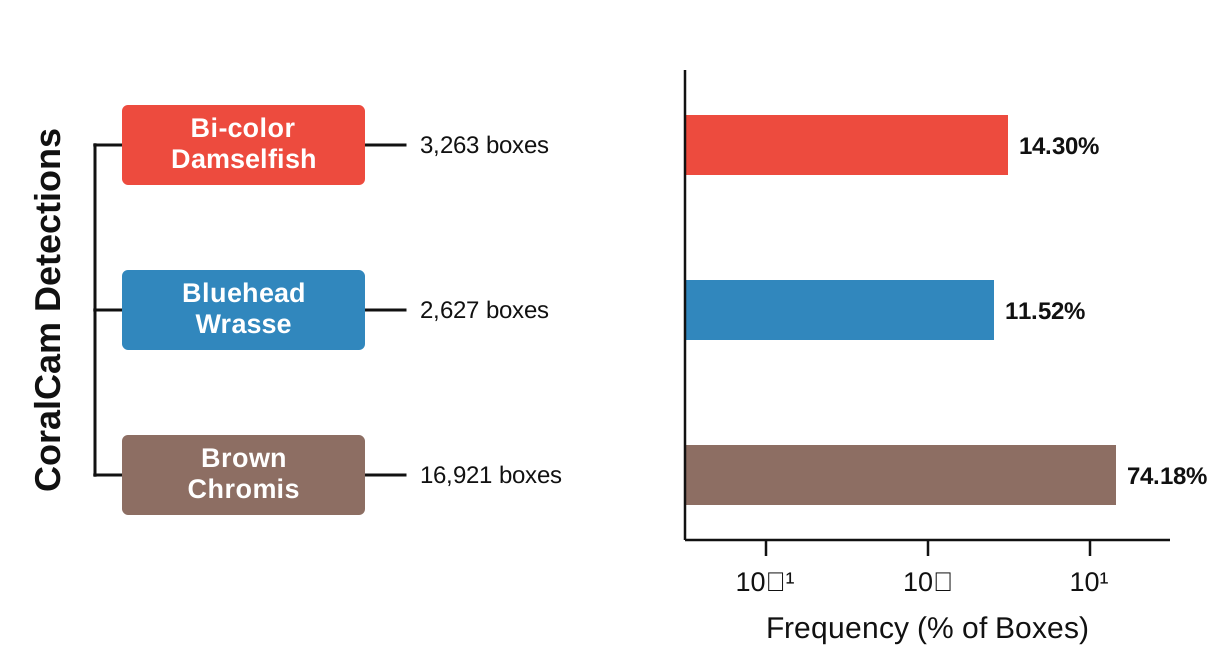
CoralCam Detection Species Distribution
Overall species composition across 22,811 CoralCam detection boxes: 3,263 bi-color damselfish,
2,627 bluehead wrasse, and 16,921 brown chromis boxes. Select to enlarge.
How it was constructed
Expert bounding boxes trained a YOLOv8 detector (AP@0.5 74.5), detections were linked with
BoTSort, and ecologists then verified selected tracks and labeled behavior frame by frame. Mouth
visibility identified frames where behavior could not be judged reliably.
Benchmark task
Classify behavior on tracked individuals in crowded, stationary reef scenes.
Divers follow individual parrotfish and surgeonfish through wild reefs in Curaçao, preserving the
camera motion and viewpoint shifts of real behavioral field observations.
Footage
8 hours · 1,799,894 frames
Capture
81 videos · 4K at 60 fps
Behavior labels
20 behaviors · frame-level
Quality control
35% independently double-annotated
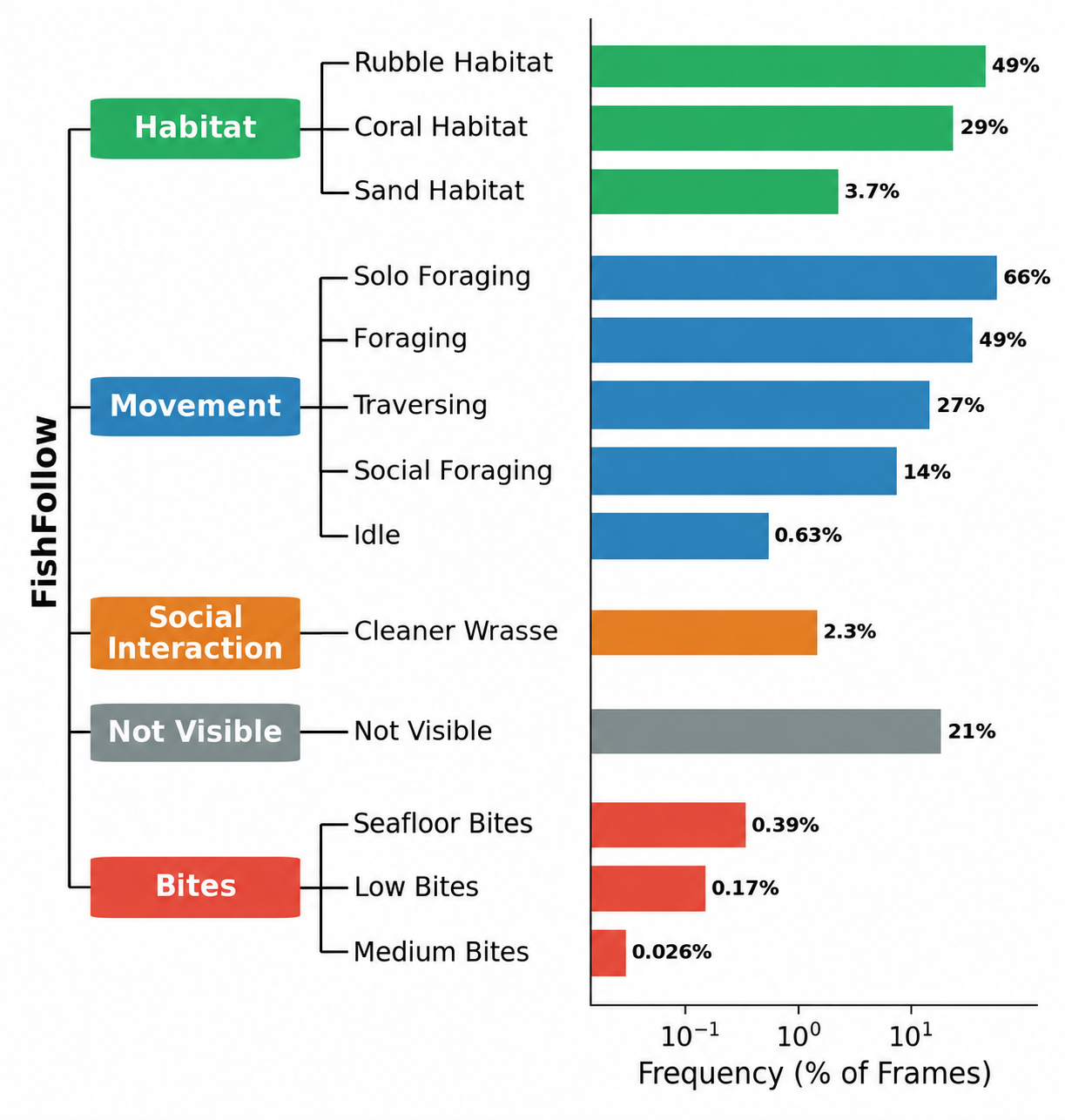
FishFollow Ethogram
FishFollow behavior ethogram. Categories organize habitat, movement, social interaction,
visibility, and feeding labels; bars show their frequency across annotated frames. Select to
enlarge.
How it was constructed
Because each recording follows one focal fish, trained annotators labeled behavior directly on
every frame without an upstream tracking stage. Agreement reached F1 0.78 at 0.25 seconds and
F1 0.93 at 0.5 seconds.
Benchmark task
Classify behavior through continuous camera motion, habitat transitions, and scale changes.
Benchmark
Modern vision foundation models learn reusable representations from large-scale image and video data,
making them promising for ecological tasks where expert labels are scarce and expensive. We use
WildFin to test whether these general features transfer to real-world fish behavior recognition and
when explicit temporal modeling is necessary.
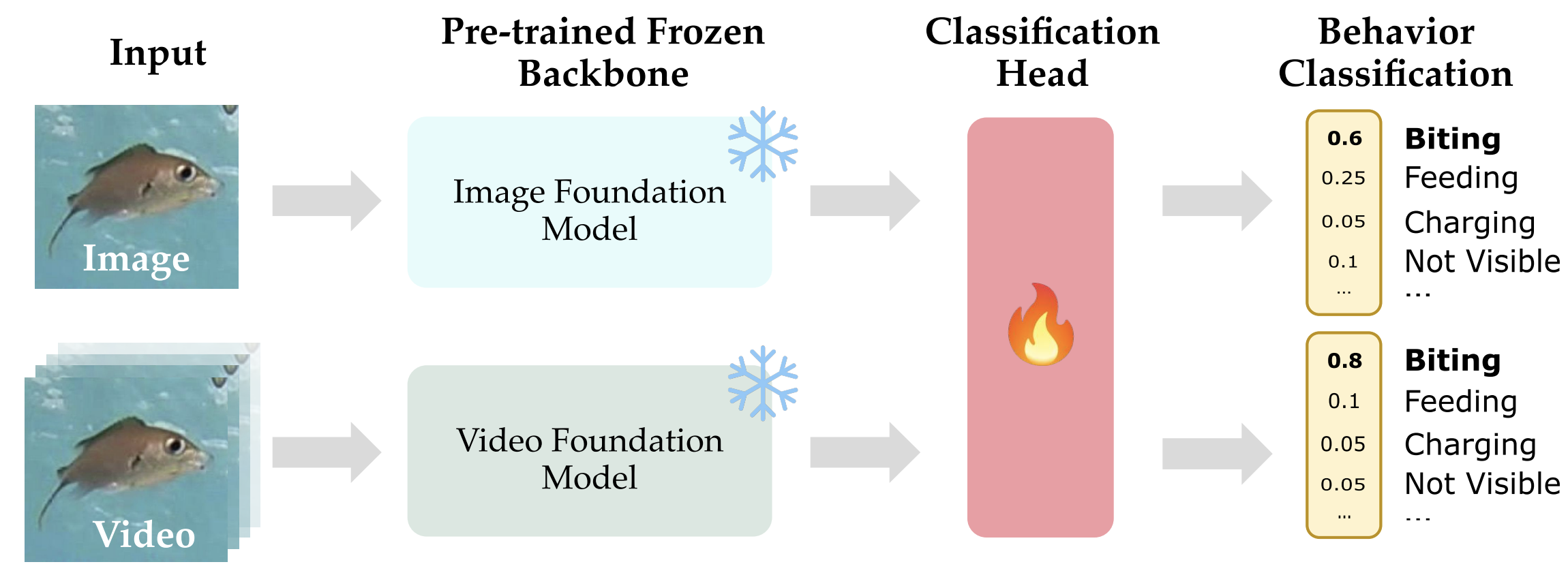
What We Evaluate
We compare image backbones (DINOv3 and ResNet50) with video backbones (VideoMAE and V-JEPA 2).
Image models process individual frames, while video models process 16-frame clips to capture
motion and interaction cues.
Adaptation Protocol
Pre-trained backbones remain frozen while lightweight mean- or cross-attention-pooling and
two-layer classification heads are trained. Performance is measured with macro F1, precision, and
recall using a ±7-frame tolerance for uncertain behavior boundaries.
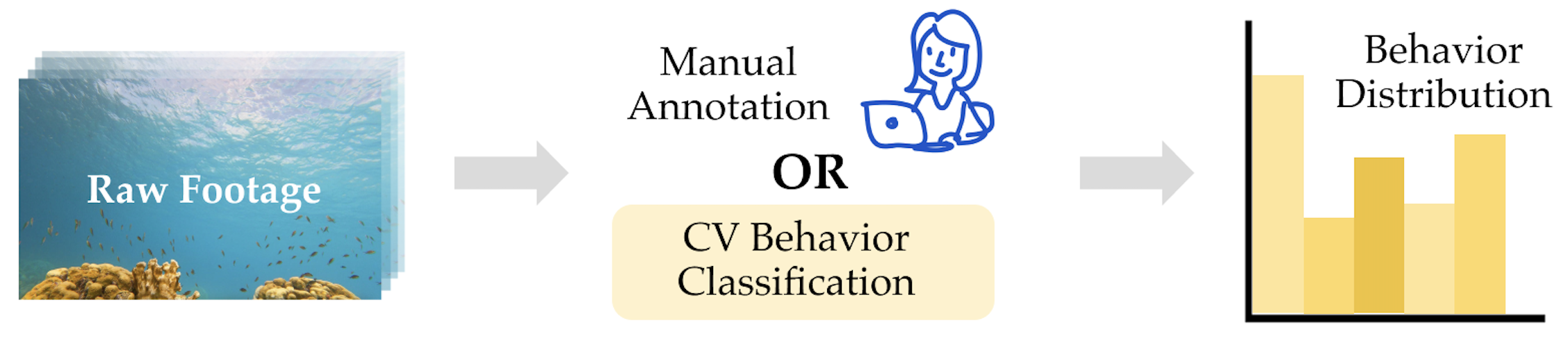
Our benchmarking pipeline for WildFin. We evaluate frozen image and video foundation models with
different classification head tuning on the behavior classification task.
Main Results
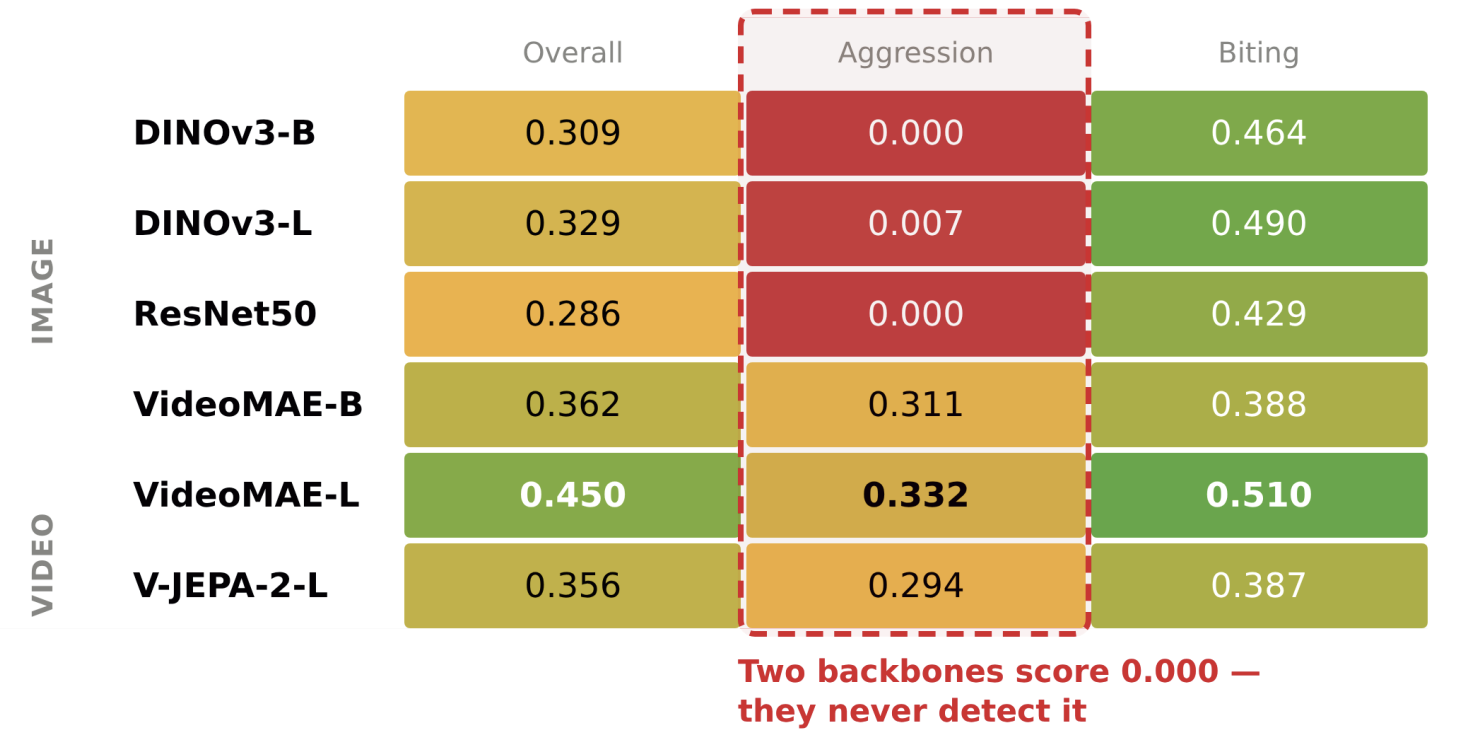
CoralCam
Temporal cues unlock dynamic behaviors
Macro-F1 by backbone and behavior category · Select to enlarge
VideoMAE-L achieves the strongest overall macro F1 (0.450). Image models remain competitive for
visually defined biting behavior, but nearly fail on aggression, where VideoMAE-L reaches 0.332.
This gap shows that interaction-driven behaviors require temporal context.
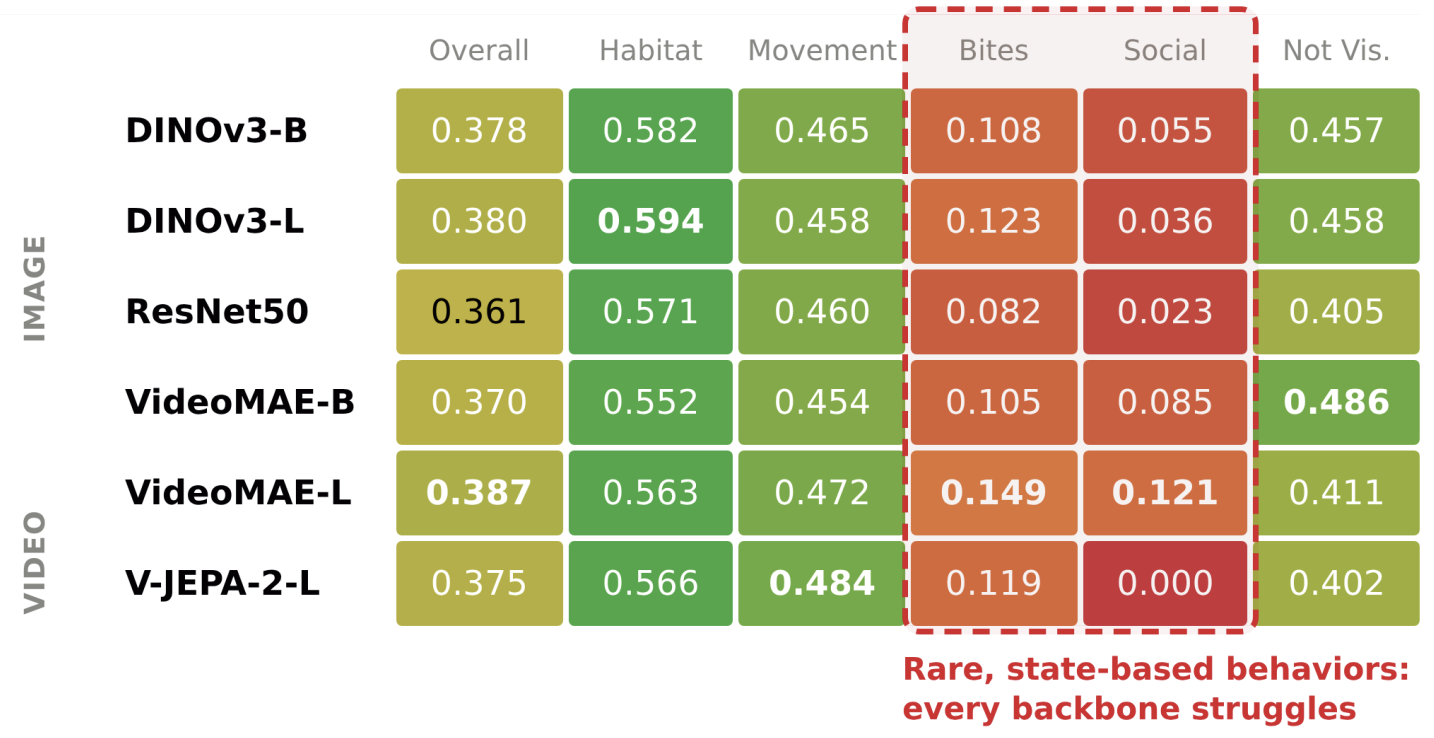
FishFollow
Appearance helps, but rare behaviors remain difficult
Macro-F1 by backbone and behavior category · Select to enlarge
Video models lead overall and on movement, while DINOv3-L performs best on habitat labels that
rely heavily on static appearance. Across architectures, performance remains low for long-tailed
bite and social-interaction classes.
Other Takeaways
Class imbalance matters
Naive random sampling produces near-zero performance on rare behaviors. Balanced sampling is
essential, while focal loss generally trades modest precision for improved recall.
Pooling is model-dependent
Cross-attention pooling improves most backbones by emphasizing informative tokens, but mean
pooling works substantially better for V-JEPA 2's distributed representations.
Full fine-tuning can overfit
A fully tuned ResNet50 is competitive on the smaller CoralCam task, but its advantage disappears
on FishFollow, where robust frozen DINOv3 features transfer better.
Comprehensive results and full ablation tables are provided in the paper and appendix.
If you find WildFin useful, please consider citing our paper:
@misc{grassick2026wildfininthewilddatasetfish,
  title         = {WildFin: An In-the-Wild Dataset for Fish Behavioral Recognition},
  author        = {Abigail G. Grassick and Jerome Tze-Hou Hsu and Ethan Lin and Ziang Liu and Max Whitton and Madelyn Hair and Liam Gutierrez and Haozheng Yu and Kristin Branson and Vivek Jayaraman and Michael A. Gil and Andrew M. Hein and Jennifer J. Sun},
  year          = {2026},
  eprint        = {2608.21281},
  archivePrefix = {arXiv},
  primaryClass  = {cs.CV},
  url           = {https://arxiv.org/abs/2608.21281}
}